

How does the 2027 Nissan Kicks compare with the 2027 Honda HR-V?
The 2027 Nissan Kicks is the stronger choice for shoppers who prioritize fuel economy, cargo flexibility, easy maneuverability, and an available all-wheel-drive system in a compact SUV. The 2027 Honda HR-V is better suited to drivers who value additional horsepower, a more substantial road feel, and a cabin based on Honda’s compact-car architecture. Final 2027 specifications have not been announced, so the figures below use the current versions of both SUVs as the most relevant comparison rather than presenting them as confirmed 2027 ratings.
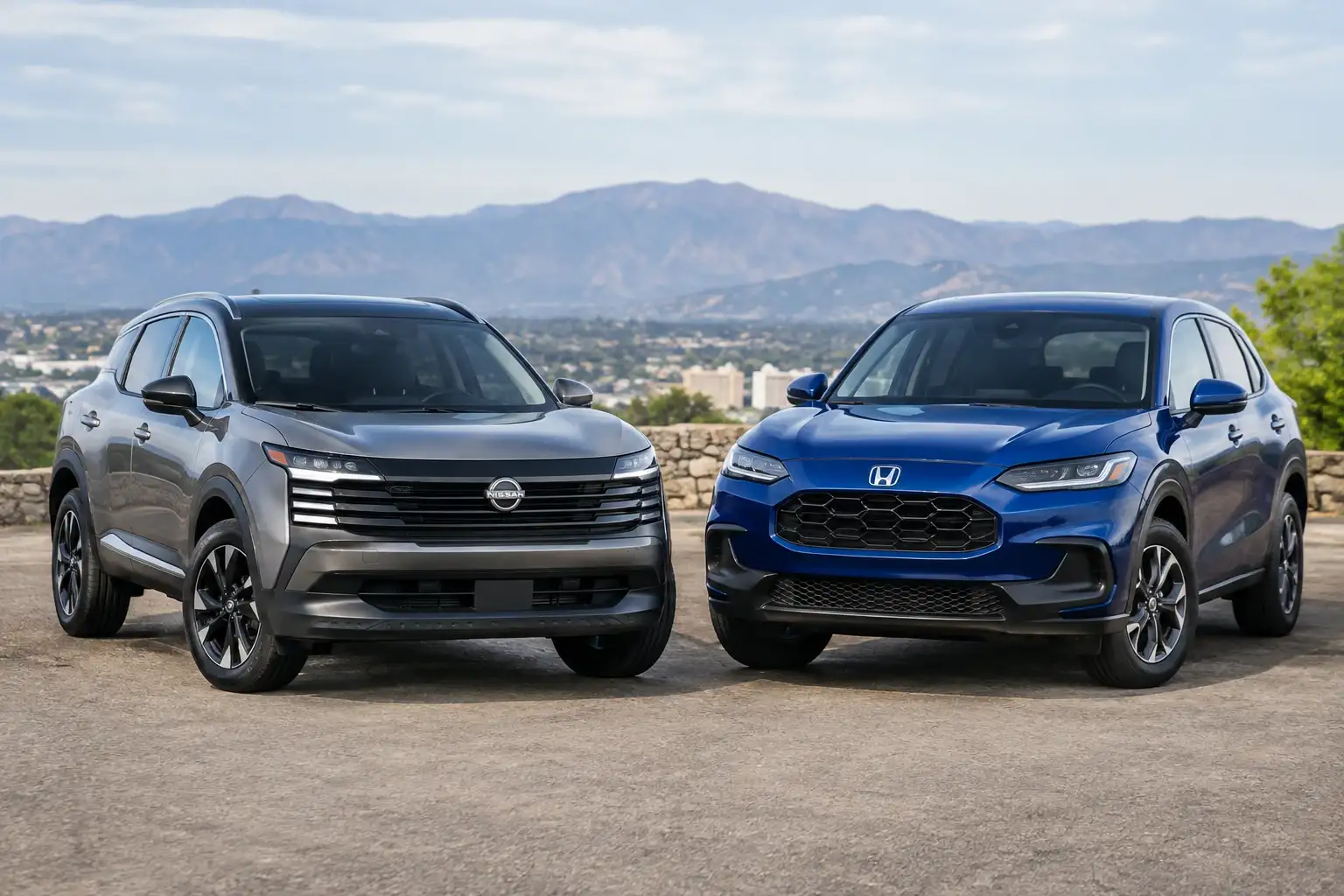
Which small SUV is better for everyday driving?
The current Nissan Kicks favors efficiency, visibility, and urban maneuverability, while the Honda HR-V feels larger and delivers more engine output. Both use four-cylinder engines with continuously variable automatic transmissions, and both are offered with front-wheel drive or all-wheel drive.
The compact footprint and upright body of the Kicks make it easy to place in parking spaces without giving up practical passenger and cargo room. The HR-V feels closer to a conventional compact crossover. Its horsepower advantage is useful when merging onto a highway, passing, or traveling with several occupants, although neither SUV is focused on high-performance acceleration.
- Choose the Kicks if fuel economy, easy parking, and cargo utility are the leading priorities.
- Choose the HR-V if stronger engine output and a heavier, more substantial driving feel matter more.
- Consider all-wheel drive if added traction on wet roads or loose surfaces is important.
How do horsepower and performance compare?
The Honda HR-V holds the horsepower advantage based on the current versions of these SUVs. The current Nissan Kicks produces 141 horsepower, while the current HR-V produces 158 horsepower. Both send power through a continuously variable transmission.
The HR-V’s 17-horsepower advantage gives it the edge during highway acceleration. It feels less strained when joining fast-moving traffic or climbing a grade with passengers aboard. The Kicks emphasizes predictable power delivery and lower fuel consumption rather than outright speed.
Peak output is only one part of the driving experience. Steering effort, outward visibility, turning space, ride quality, brake response, and seat comfort also affect daily satisfaction. A useful comparison drive should include low-speed streets, parking maneuvers, a highway entrance, and uneven pavement.
Which SUV is more fuel-efficient?
The current Nissan Kicks has the fuel-economy advantage in both front-wheel-drive and all-wheel-drive form. The front-wheel-drive Kicks is EPA-estimated at 31 mpg combined, compared with 28 mpg combined for the front-wheel-drive HR-V. With all-wheel drive, the Kicks is EPA-estimated at 30 mpg combined, while the HR-V is rated at 27 mpg combined.
These EPA estimates are reference points for the current models, not confirmed 2027 results. A new model year can bring changes to equipment, vehicle weight, wheel choices, powertrain calibration, or certification. Actual fuel consumption also responds to traffic, speed, temperature, tire pressure, cargo load, and driving style.
For shoppers trying to reduce fuel stops without moving to a hybrid or electric vehicle, the Kicks has the clearer advantage. Its three-mpg combined lead remains consistent across the current front-wheel-drive and all-wheel-drive configurations.
Does the Nissan Kicks or Honda HR-V have more cargo space?
The answer changes with the drivetrain selected for the Kicks. Current front-wheel-drive Kicks models provide 30 cubic feet behind the rear seats and 60 cubic feet with them folded. The current Honda HR-V offers 24.4 cubic feet behind its second row and 55.1 cubic feet with that row folded.
Choosing all-wheel drive changes the cargo calculation because the rear drivetrain and suspension packaging reduce space in the Kicks. The current all-wheel-drive version provides 23.9 cubic feet behind the rear seats and 50.1 cubic feet with them folded. As a result, a front-wheel-drive Kicks leads the HR-V in both cargo measurements, while the HR-V has a slight advantage over an all-wheel-drive Kicks.
Cubic-foot ratings do not tell the entire story. Hatch width, load-floor height, wheel-well intrusion, and the shape of the folded seatbacks determine how easily luggage, groceries, pet equipment, or flat-pack boxes fit. Shoppers with a specific cargo need should compare those details in person.
How do their interiors and technology differ?
The Nissan Kicks uses a modern, screen-focused dashboard, with larger digital displays offered on higher trims. Its upright seating position and broad windshield support visibility in traffic and parking areas. Current available equipment includes wireless smartphone integration, an Around View Monitor, heated front seats, and a premium audio system.
The HR-V has a lower, more car-like dashboard influenced by the Honda Civic. Its controls are straightforward, and upper trims add features such as leather-trimmed seating surfaces, heated front seats, and a larger infotainment display. Exact 2027 trim assignments and standard-versus-optional equipment could change when the new model-year details are released.
Important items to compare during a test drive include:
- Infotainment response and smartphone connectivity
- Climate controls and frequently used physical buttons
- Front-seat adjustment and rear-seat access
- Camera clarity and outward parking visibility
- Rear legroom with the driver’s seat in its normal position
What driver-assistance features should shoppers compare?
Both model lines offer active safety and driver-assistance technology, but their equipment levels and controls differ. Current Kicks models include automatic emergency braking, lane-departure warning, blind-spot warning, and rear cross-traffic alert, with additional assistance available on selected trims. The HR-V includes Honda Sensing features such as collision-mitigation braking, road-departure mitigation, lane-keeping assistance, and adaptive cruise control.
Feature names do not guarantee that two systems respond identically. Compare how each SUV communicates warnings, where assistance settings appear, and which functions are included on the specific trim being considered. Driver-assistance systems support attentive driving rather than replacing it.
Which 2027 small SUV should you choose?
The 2027 Nissan Kicks belongs high on the list for shoppers seeking strong fuel economy, useful front-wheel-drive cargo capacity, compact exterior dimensions, and available all-wheel drive. The 2027 Honda HR-V is the more natural candidate for drivers who prioritize additional horsepower, a larger-vehicle feel, and Honda’s cabin layout.
Front-wheel drive gives the Kicks its clearest combination of efficiency and cargo advantages. In all-wheel-drive form, the Kicks retains its current fuel-economy lead, but the HR-V provides more cargo room. That makes drivetrain choice an important part of this comparison rather than a minor configuration detail.
Explore the Nissan Kicks at Ancira Nissan
Ancira Nissan is a relevant next step for shoppers comparing these subcompact SUVs. Visit the dealership’s Nissan Kicks page to review listed models and configurations without assuming that 2027 vehicles are currently available. When final 2027 details are released, compare the exact drivetrain, EPA fuel-economy rating, cargo specification, trim equipment, and driver-assistance features before making a decision.